Gdańsk: History, Freedom and Autumn by the Baltic Sea

Some cities offer you beautiful buildings, charming streets, and picturesque squares.
Others feel like they have a memory.
You walk through their streets and somehow sense that you are not only looking at the present, but also walking through everything the city has experienced before.
Gdańsk feels like one of those cities to me.
Located in northern Poland on the Baltic Sea, Gdańsk is a city of ports, merchants, shipyards, historic architecture, museums, and long walks by the water. With more than a thousand years of history, it has been shaped by different cultures, political powers, languages, wars, and trade routes. During the Middle Ages, it became an important trading and port city and was part of the Hanseatic League, connecting it to the wider commercial world of the Baltic.
I will be visiting Gdańsk for the first time this October.
And somehow, I think discovering it in autumn might be even more interesting than visiting in the middle of summer.
A little colder. A little quieter. A little more atmospheric.

A Fairytale-Like Old Town
One of the first things that attracts visitors to Gdańsk is its architecture.
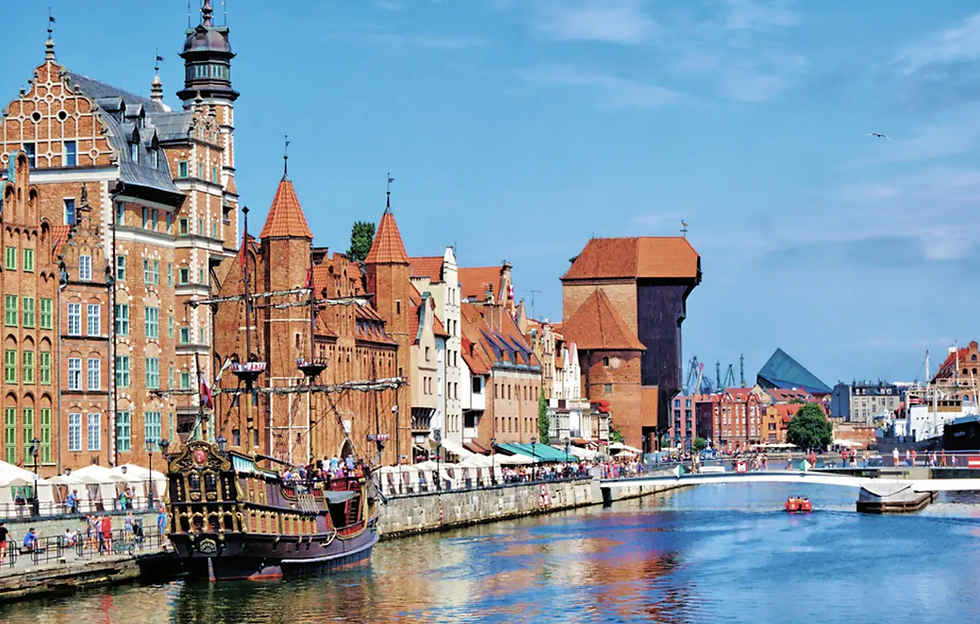
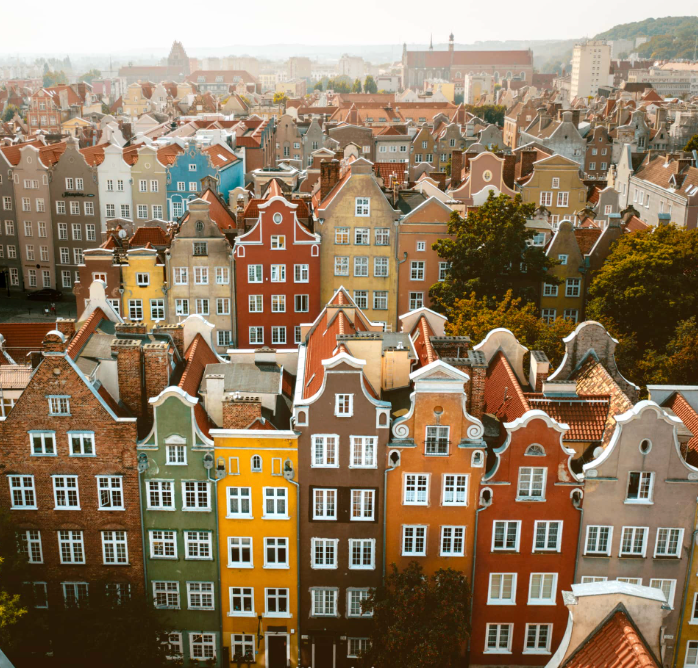
The historic Main Town is filled with colourful façades, narrow streets, old merchant houses, churches, cafés, and impressive historical buildings.
Długa Street and Długi Targ form the heart of this part of the city. Together, they make up part of the historic Royal Route, where kings and important visitors once entered the city.
One of the most recognizable landmarks here is the Neptune Fountain.
Created in the early seventeenth century, the fountain has become one of Gdańsk’s most famous symbols. Just behind it stands Artus Court, a historic meeting place for merchants and an important centre of social and commercial life in the old city.
Then there is the Main Town Hall, another impressive reminder of Gdańsk’s wealth and importance during its trading years.
And above all of this rises one of the city’s most spectacular buildings:
St. Mary’s Basilica.
With its enormous brick structure and 82-metre tower, it is one of the largest brick churches in the world. Visitors can also climb the tower for a panoramic view over the city.
Walking through these streets, it is easy to understand why Gdańsk is sometimes described as one of Poland’s most beautiful historic cities.
But its story is much more complicated than its beautiful façades suggest.
A City Shaped by War
Gdańsk carries some of the darkest chapters of European history.
On 1 September 1939, the German attack on Poland began at Westerplatte, near Gdańsk. The event is widely regarded as one of the symbolic starting points of the Second World War.
The war devastated the city. Much of historic Gdańsk was destroyed, and the city later went through an enormous reconstruction process.
Today, one of the best places to understand this history is the Museum of the Second World War.
The museum presents the war from a broad international perspective rather than telling only the story of one country. Its main exhibition is located underground and explores the experiences of civilians, soldiers, nations, and societies affected by the conflict.
Then there is Westerplatte itself.
Standing there, by the Baltic Sea, seems like it would be a very different experience from simply reading about the beginning of the war in a history book.
It is one of those places where geography and history suddenly become the same thing.
Gdańsk and the Idea of Freedom
Perhaps the most fascinating part of Gdańsk’s modern history comes after the Second World War.
In 1980, workers at the Gdańsk Shipyard went on strike. The movement eventually developed into Solidarity (Solidarność), led by Lech Wałęsa.
Solidarity became one of the most important social and political movements in modern European history. It challenged the communist government in Poland and played a major role in the political transformations that eventually spread across Eastern Europe.
Today, this history can be explored at the European Solidarity Centre.
This is one of the places I am particularly looking forward to visiting.
Because it tells us something important about Gdańsk:
The city is not famous only because of its medieval buildings or its location on the Baltic Sea.
It is also a city where ordinary people became part of an extraordinary political transformation.
A city where a workers’ movement became a symbol of freedom.
The Baltic’s Gold
There is another material that has been closely associated with Gdańsk for centuries:
Amber.
Baltic amber has been traded throughout the region for thousands of years and has become one of the defining cultural symbols of the Baltic coast.
Gdańsk is particularly famous for its amber jewellery and craftsmanship.
The Amber Museum explores the history, geology, culture, and artistic use of this fascinating material.
When you think about Gdańsk as a historical trading city, amber makes perfect sense.
The sea brought ships.
The ships brought merchants.
The merchants brought goods, ideas, languages, and cultures.
And amber became one of the treasures travelling along those routes.
Art, Science and Culture
Gdańsk is not only interesting for history lovers.
The city also has a strong artistic and intellectual heritage.
The National Museum houses important works of European art, including Hans Memling’s famous The Last Judgement.
The city also has the Gdańsk Shakespeare Theatre, a modern cultural institution built around the city’s historical connection with Shakespearean theatre.
And Gdańsk has produced some remarkable scientists.
Astronomer Johannes Hevelius was born here, as was Daniel Gabriel Fahrenheit, whose name most of us know from the Fahrenheit temperature scale.
So behind the colourful buildings and tourist attractions, there is also a history of science, art, literature, and intellectual life.
Beyond the Old Town
One of the things I like about Gdańsk is that you don’t have to stay within the historic centre.
The Oliwa district offers a completely different atmosphere.
There is Oliwa Cathedral, famous for its impressive organ, and Oliwa Park, a beautiful place for a quieter walk.
And then, of course, there is the Baltic Sea.
Gdańsk has several beaches, including Stogi, Brzeźno, Jelitkowo, and Sobieszewo.
October probably won’t be the season for swimming.
But honestly, that might not matter.
A long walk beside a cold, windy Baltic Sea sounds like a pretty good way to spend an autumn afternoon.
Gdańsk, Sopot and Gdynia
Gdańsk is also part of a larger urban area known as the Tricity.
Together with Sopot and Gdynia, it forms one of the most interesting metropolitan areas in northern Poland.
Sopot is known for its seaside resort atmosphere and famous pier, while Gdynia has a more modern character, with its port, maritime history, and modernist architecture.
So visiting Gdańsk doesn’t necessarily have to mean staying in one city.
It can become a small Baltic adventure.
Gdańsk for history.
Sopot for the seaside.
Gdynia for modern Poland.
So, What Kind of City Is Gdańsk?
I haven’t been there yet.
So everything I know so far comes from photographs, books, maps, stories, and the history of the city.
But I have a feeling Gdańsk is the kind of place where beauty and history constantly overlap.
You can stand beside a colourful seventeenth-century building and then, a few streets later, find yourself thinking about the Second World War.
You can walk along the Motława River and see the old medieval crane, then visit a museum telling the story of a workers’ movement that helped change Europe.
You can look at amber jewellery in a shop and remember that this city has been connected to Baltic trade for centuries.
And then you can simply walk to the beach and look at the sea.
Gdańsk is a port city.
A trading city.
A historic city.
A city of war.
A city of art and science.
And, perhaps most importantly, a city of freedom.
I will be arriving there this October, after travelling through Poland for several Erasmus+ projects.
I don’t know yet what Gdańsk will actually feel like.
Maybe it will be colder than I expect.
Maybe the Baltic wind will be brutal.
Maybe the streets will be quiet and grey under an October sky.
Or maybe that will be exactly what makes it beautiful.
Because sometimes the best way to experience a city is not under perfect blue skies, surrounded by crowds of tourists.
Sometimes it is better to arrive when the season has changed, put on a warm coat, walk along the river, listen to the sound of the wind, and let the city tell you its own story.
And that is exactly how I want to discover Gdańsk.
Not simply as another destination on a map.
But as a city with a thousand years of stories behind it.
A city where the Baltic Sea, history, and freedom meet.
Places I Want to See in Gdańsk
Długa Street and Długi Targ
The Royal Route
Neptune Fountain
Artus Court
Main Town Hall
St. Mary’s Basilica
The Crane and Motława River
Amber Museum
European Solidarity Centre
Museum of the Second World War
Westerplatte
Oliwa Cathedral
Oliwa Park
Gdańsk’s Baltic beaches
Gdańsk Shakespeare Theatre
Sopot
Gdynia
Perhaps the best way to explore Gdańsk is not to see these places as a checklist of tourist attractions.
Instead, follow the city’s story.
And that story begins with the sea.


Yorumlar